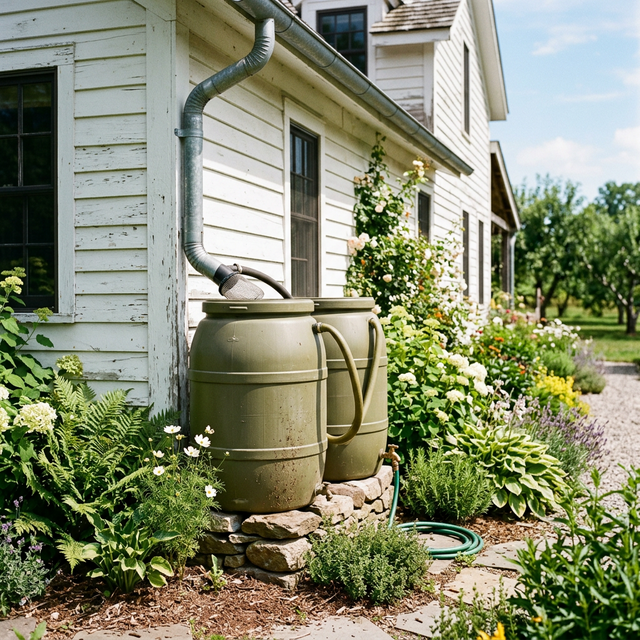
Plants objectively prefer rainwater. Unlike municipal water, which is sterilized with chlorine and fluoride, rainwater is naturally slightly acidic, highly oxygenated, and captures microscopic amounts of valuable nitrogen from the atmosphere as it falls.
If you have a metal roof (or an asphalt roof if you are only watering ornamental non-edibles), you have a massive, free water catchment system sitting directly above your head.
The "1 Inch" Math Equation
Before you invest in infrastructure, you need to know how much water you stand to gain. The math is astonishingly simple: 1 inch of rain falling on 1 square foot of roof yields 0.62 gallons of water.
If your barn roof is 20x20 feet (400 square feet), a modest 1-inch thunderstorm will yield 248 gallons of water pouring out of your gutters. Do you have a place to put it?
Building a $100 System
Commercial cisterns cost thousands of dollars. We are going to build a functional system using upcycled materials.
1. Sourcing the Barrels
The gold standard for DIY rainwater harvesting is the 55-gallon food-grade plastic barrel. Do not buy these new ($80+). Look on Facebook Marketplace or Craigslist for local food manufacturing plants, breweries, or dairies. They often sell empty syrup or juice barrels for $10 to $20 each. Never use barrels that previously held chemicals or petroleum products.
2. The "First Flush" Diverter
When it hasn't rained in weeks, your roof collects dust, bird droppings, and leaves. When the rain finally falls, the first 5-10 gallons that wash off the roof are filthy.
A "first-flush diverter" is a simple PVC 'T-joint' installed in your downspout. It routes the initial, dirty water into a separate capped pipe. Once that pipe fills up, the clean water flows over the top and into your rain barrels.
💰 Budgeting Your Homestead Upgrades
A 4-barrel rainwater system should cost under $150 if you source the materials smartly.
HomesteadHelper Pro features a dedicated Farm Financial Tracker. Log the cost of your PVC, bulkheads, and barrels as an "Infrastructure Upgrade" and immediately deduct it from the money you save on your summer utility bills. See exactly when your system pays for itself!
Get HomesteadHelper Pro — $393. The Daisy Chain
As established above, a single storm will easily overflow a single 55-gallon barrel. To maximize capacity, you must "daisy-chain" several barrels together.
- Install a brass bulkhead fitting at the very bottom of Barrel A and Barrel B.
- Connect them with a short piece of flexible hose.
- As water fills Barrel A from the top, gravity will force the water through the hose at the bottom, automatically leveling and filling Barrel B simultaneously.
- Install a simple spigot on the final barrel in the chain to attach your garden hose.
4. Gravity and Pressure
Water pressure is determined by elevation, not volume. For every 2.3 feet you elevate your barrels off the ground, you gain 1 PSI of water pressure. If your barrels sit flat on the ground, the water will barely trickle out of an attached garden hose.
Always elevate your barrels on a sturdy foundation of cinder blocks or pressure-treated 4x4 posts (remember, a full 55-gallon barrel weighs over 450 lbs!). Getting them 2-3 feet off the ground allows you to attach a hose and comfortably reach your garden beds using just the power of gravity.